
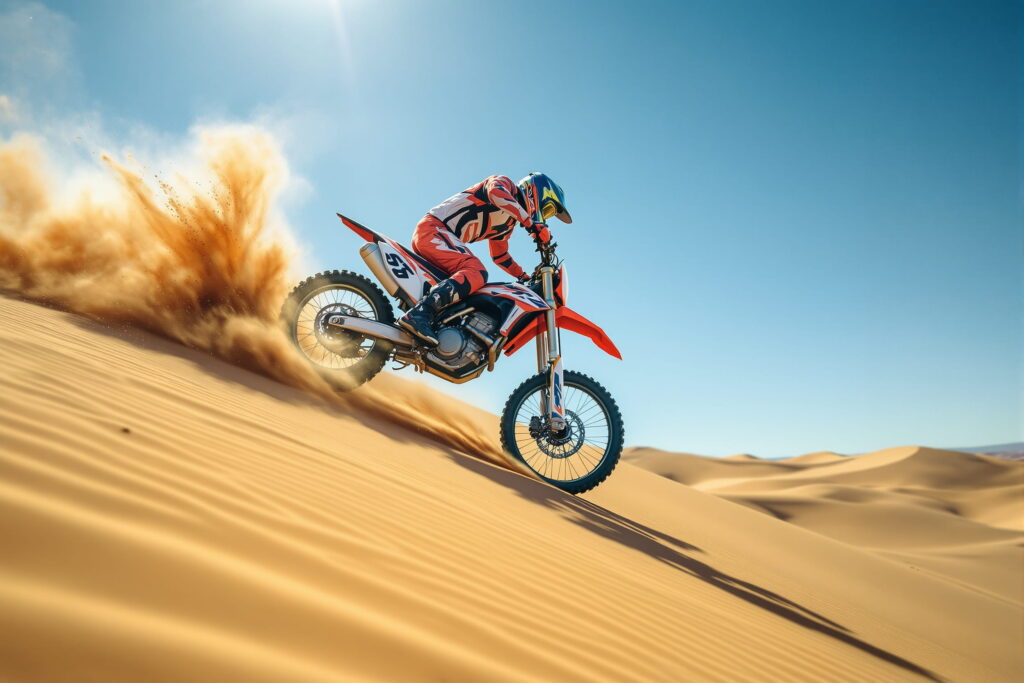
Riding on sand is one of the most humbling experiences in off-road motorcycling. The ground shifts beneath your tires, traction disappears unpredictably, and momentum is your only lifeline. In the Kalahari and Namibian dunes near our routes, riders learn quickly that brute force is less effective than refined technique.
When you transition from hard-packed dirt to deep, soft sand, every input you give the motorcycle feels different. The front wheel wants to tuck, the rear wheel wants to dig a trench, and the engine has to work twice as hard just to maintain your current speed. It is a physically demanding environment that requires a complete shift in your riding approach.
Fortunately, mastering sand dunes is entirely possible with the right knowledge. By adjusting your body position, understanding how to manage your throttle, and making a few strategic changes to your bike setup, you can turn a frustrating struggle into a thrilling desert adventure. This guide covers the essential enduro riding techniques you need to conquer the sand, along with specific advice for tackling the legendary dunes of Southern Africa.
Core Principles for Conquering Sand
Riding a dirt bike in the sand requires you to unlearn a few habits that work well on solid ground. You have to embrace a looser, more fluid riding style.
The Magic of Momentum
Momentum is your best friend in the sand. If you ride too slowly, the front tire will plow into the soft surface, causing the steering to feel heavy and unstable. This often leads to a sudden loss of balance or a stall.
By keeping your speed up, you allow the motorcycle to float on top of the sand rather than sinking into it. This “hydroplaning” effect makes steering lighter and keeps the bike moving forward predictably. You must commit to maintaining a steady pace, especially when approaching deeper sections or the base of a dune. Hesitation usually results in getting stuck.
Perfecting Your Body Position
Your body position directly influences how the bike handles the shifting terrain. On hard dirt, you might keep your weight relatively centered. In the sand, you need to shift your weight backward.
Stand up on the footpegs and grip the bike firmly with your knees and ankles. Keep your knees slightly bent to absorb unexpected bumps. By shifting your hips back, you unweight the front suspension. This prevents the front tire from digging in and allows it to glide over the surface. A light grip on the handlebars is equally important. The front end will naturally twitch and wander as it tracks through the sand. Let the bike dance around a bit beneath you instead of fighting every small movement.
Essential Skills for Sand Dunes
Beyond your basic stance, how you manipulate the bike’s controls will determine your success in deep sand environments.
Throttle Control and Gear Selection
Aggressive, choppy throttle movements will instantly bury your rear tire. Sand riding requires smooth, consistent power delivery. Keep the throttle open and steady to maintain your forward drive.
Riding a gear higher than you normally would is a highly effective technique. A higher gear softens the power delivery, which helps the rear tire find traction instead of violently spinning and digging a hole. If you feel the engine starting to bog down, a quick, smooth slip of the clutch can bring the RPMs back up without forcing you to downshift and lose your precious momentum.
Adjusting Your Bike Setup
A few quick adjustments to your enduro motorcycle can make a massive difference in how it handles the dunes.
First, lower your tire pressure. Dropping your tire pressure increases the footprint of the rubber, providing significantly more traction and flotation. Just be cautious of flat tires if you encounter rocky sections between the dunes.
Second, consider adjusting your suspension. Stiffening the compression damping slightly can keep the bike higher in its stroke, preventing it from wallowing in the soft dips. Finally, ensure your air filter is clean and properly oiled, perhaps even using a dust cover. Sand and silt are highly abrasive and can destroy an engine rapidly if they bypass the filter.
Navigating the Kalahari and Namibian Dunes
Southern Africa offers some of the most spectacular and challenging sand riding in the world. However, the environments of the Kalahari and the Namib differ significantly, requiring slightly different approaches.
Characteristics of the Kalahari
The Kalahari Desert is a massive, sand-covered plain featuring distinctive red sand, colored by a thin layer of iron oxide. It is characterized by long chains of longitudinal dunes separated by broad, parallel depressions known as “straten” (streets).
When riding in the Kalahari, you can often use these straten to make excellent time, keeping your momentum high on the relatively flatter ground before peeling off to crest a dune. The Kalahari also experiences extreme temperature shifts. Shade temperatures can soar during summer days and drop to freezing on winter nights. Managing your physical exertion is critical. Stay hydrated, ride smoothly to conserve your energy, and try to tackle the hardest sections during the cooler hours of the morning.
Tackling the Namibian Coastal Dunes
The Namib Desert presents a different beast entirely. It features some of the tallest sand dunes on the planet, heavily influenced by coastal winds. The sand here can be incredibly fine and soft, especially on the slip faces (the steep, downwind sides of the dunes).
Climbing these massive dunes requires supreme commitment. You need a long run-up to build maximum speed, and you must hold the throttle wide open all the way to the crest. As you approach the top, roll off the throttle smoothly so you don’t launch over the blind edge. Reading the wind direction is a vital skill here, as it tells you which side of the dune will be a gentle climb and which side drops off steeply.
Ready to Ride the Desert
Conquering sand dunes takes practice, patience, and a willingness to trust the motorcycle. It feels unnatural at first, but once you experience the sensation of floating across a sea of sand, it becomes incredibly addictive.
Focus on keeping your weight back, maintaining a steady throttle, and letting the front wheel find its own way. If you prepare your bike correctly and respect the environment, the deserts of the world become the ultimate off-road playground. Start practicing your deep-sand techniques locally, and soon you will be ready to tackle the sweeping red longitudinal dunes of the Kalahari and the towering peaks of the Namib.