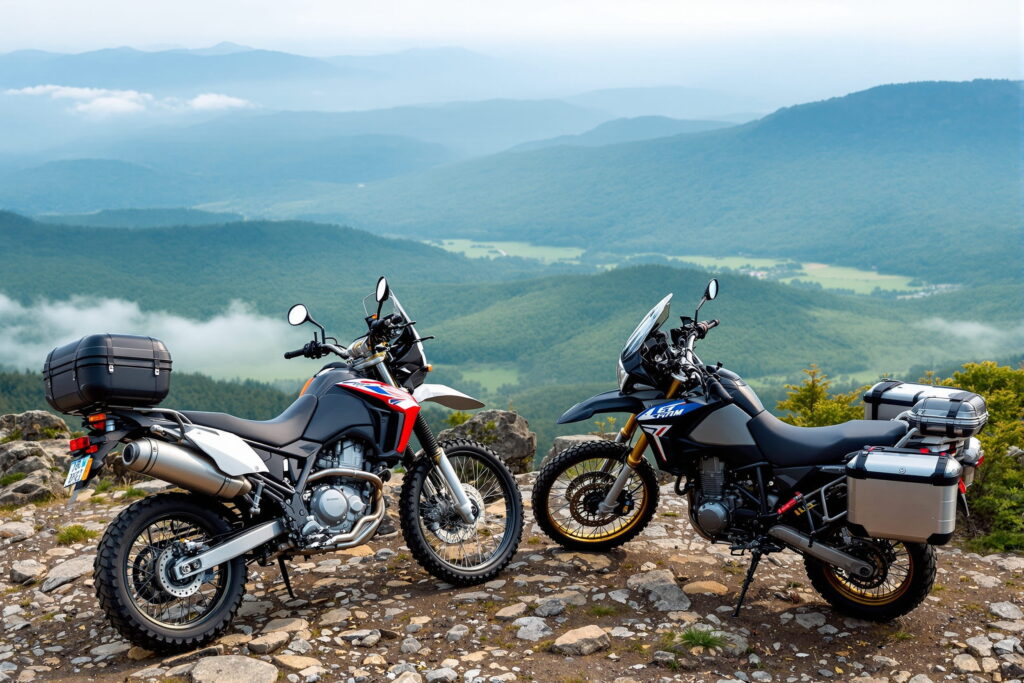
We compare lightness and comfort across demanding routes to help riders choose the best motorcycle. Selecting the right bike often feels like an impossible compromise between conquering rugged single-track trails and cruising comfortably down the interstate. Every rider has a unique vision of the perfect trip, and the motorcycle you choose dictates exactly what kind of terrain you can explore.
Motorcycle manufacturers have spent decades engineering machines that blend street legality with off-road capability. This evolution has led to two distinct categories dominating the market: dual-sports and adventure bikes. While they might look similar to the untrained eye, their underlying DNA, design philosophies, and ideal use cases are entirely different.
Understanding these differences is the crucial first step before you invest in a new machine. By examining how these motorcycles handle various environments, you can align your purchase with your actual riding goals.
Defining the Dual-Sport Motorcycle: Lightness and Off-Road Prowess
A dual-sport motorcycle is essentially a dirt bike that has been modified just enough to be street legal. Manufacturers add mirrors, turn signals, a headlight, and an exhaust system that meets emission standards. The primary focus remains strictly on off-road performance and agility.
These bikes usually feature single-cylinder engines, narrow seats, and minimal bodywork. The lack of fairings and heavy accessories keeps the weight incredibly low, allowing riders to muscle the bike through sand, mud, and steep rocky inclines. Because they are so stripped down, dual-sports thrive in environments where heavier motorcycles would quickly become bogged down or exhausted the rider.
If your route involves jumping logs, navigating deep ruts, or spending the vast majority of your day standing on the pegs in challenging dirt, the dual-sport is built precisely for that environment.
Defining the Adventure Bike: Comfort and Long-Distance Capability
Adventure bikes (commonly known as ADVs) take a completely different approach. They are the SUVs of the motorcycle world, designed to carry a rider, a passenger, and heavy luggage across continents in total comfort.
ADVs typically feature larger multi-cylinder engines, providing smooth, vibration-free power at highway speeds. They come equipped with tall windshields, wide, plush seats, and sophisticated electronics suites including traction control and cruise control. This design prioritizes rider endurance over long distances.
While they possess off-road capabilities, ADVs are tailored for sweeping gravel roads and dirt double-tracks rather than tight, technical woods riding. The heavy emphasis on road manners makes them the go-to choice for riders who need to cover hundreds of miles of asphalt just to reach the dirt.
Key Differences: Weight, Suspension, and Fuel Capacity
To truly understand which bike fits your needs, you must look at the mechanical differences separating the two classes.
Weight Disparities
Weight dictates everything off-road. A typical dual-sport weighs between 250 and 350 pounds. This featherweight class allows you to easily pick the bike up after a drop and maneuver it through tight spaces. Adventure bikes regularly tip the scales at 450 to over 600 pounds. Pushing a 550-pound adventure bike out of deep mud requires immense physical effort and can end a riding day early.
Suspension Dynamics
Dual-sport motorcycles feature long-travel suspension dialed in for absorbing harsh impacts, jumps, and massive rocks. The suspension is incredibly plush but can feel a bit unstable or “divey” under hard braking on the street. Adventure bikes use stiffer suspension setups. They still offer decent travel for unpaved roads, but the valving is tuned to handle the massive weight of the bike plus luggage, ensuring the motorcycle remains stable and predictable at 75 miles per hour on the highway.
Fuel Capacity and Range
Fuel range is a critical factor for remote travel. Dual-sports usually carry between two and three gallons of gas, limiting their range to around 100 miles before needing a refill. Adventure bikes feature massive fuel tanks, often holding five to eight gallons. This gives ADVs a range of 250 miles or more, allowing riders to cross vast, empty stretches of desert or highway without strapping extra fuel cans to the rear rack.
Performance on Demanding Routes: Technical Trails vs. Highway Miles
Your chosen route will instantly highlight a bike’s strengths and weaknesses. Take a dual-sport onto a technical mountain trail, and the machine feels like an extension of your body. The lightweight chassis responds instantly to steering inputs. However, take that same dual-sport onto a windy interstate for four hours, and the experience becomes grueling. The light weight makes it susceptible to crosswinds, the single-cylinder engine buzzes heavily at high RPMs, and the narrow seat becomes highly uncomfortable.
Conversely, an adventure bike dominates the highway. You can sit behind the protective windscreen, turn on the heated grips, and comfortably devour miles. Once you turn off the highway onto a fire road, the ADV remains poised and enjoyable. But if that fire road turns into a washed-out, boulder-strewn goat path, the adventure bike’s massive weight and street-biased geometry will fight you every step of the way, making the ride stressful rather than fun.
Maintenance and Durability Considerations
Maintenance schedules vary wildly between these two categories. High-performance dual-sports often measure maintenance intervals in hours rather than miles. You might find yourself changing the oil every 15 hours of riding and checking valve clearances frequently. However, their simple, single-cylinder designs make them very easy to work on yourself. When dropped, dual-sports rarely suffer catastrophic damage; their plastic fenders just bend and bounce back.
Adventure bikes boast long service intervals, often going 6,000 to 10,000 miles between oil changes. This makes them far superior for multi-month cross-country trips. The downside is their complexity. Servicing a modern ADV often requires removing extensive bodywork and interacting with complex electronics. Furthermore, dropping a heavy adventure bike can easily result in broken fairings, smashed turn signals, and expensive repair bills.
Which for Your Journey? (How to Choose)
Choosing the right motorcycle comes down to an honest assessment of your riding ratio.
If you plan to ride 80 percent dirt and 20 percent street, lean heavily toward a dual-sport. It will make the off-road portions thrilling and manageable, even if you have to endure some discomfort on the pavement to get there.
If your trips consist of 80 percent pavement and 20 percent dirt roads, an adventure bike is the clear winner. The comfort, luggage capacity, and highway capability will keep you fresh for days on end, and it will handle the occasional dirt road with ease.
Always buy for the riding you actually do, not the riding you fantasize about doing once a year.
Start Planning Your Two-Wheeled Expedition
Both dual-sports and adventure bikes offer incredible platforms for exploring the world, but they solve entirely different problems. A dual-sport trades road comfort for off-road dominance, while an adventure bike sacrifices agility in the dirt for long-distance touring luxury. Assess your routes, evaluate your off-road skill level, and consider how much gear you truly need to carry. Once you align your motorcycle with your actual travel style, you can stop worrying about the machine and focus entirely on the journey ahead.